
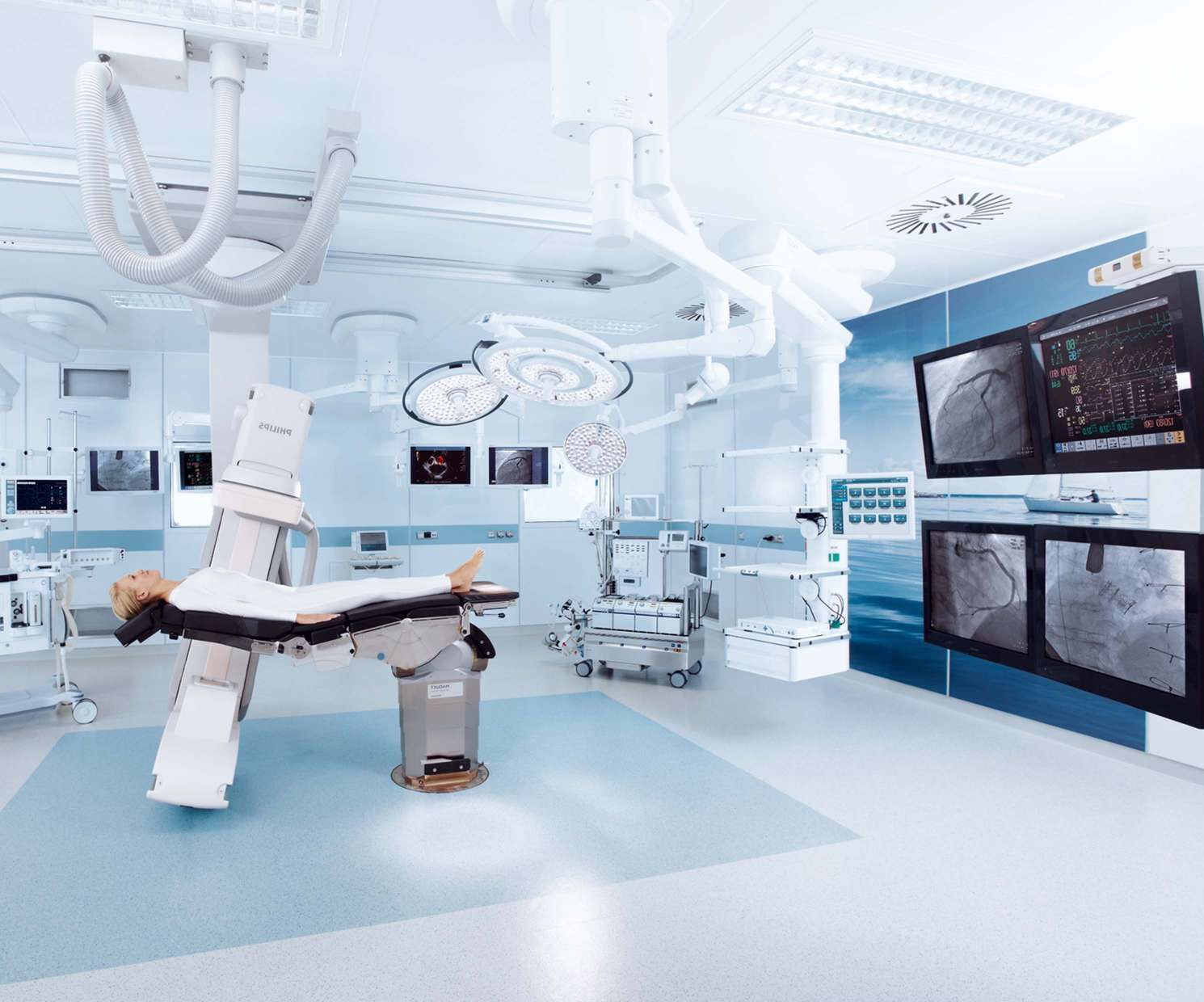
How laminar airflow protects the surgical zone
Filtered air flows down over the operating table and leaves at the room corners. The geometry of the room is what keeps the zone clean.

Hospital-acquired infection is a leading cause of death. Figures quoted by health authorities put it at about 90,000 deaths a year in the United States, and the problem is larger in countries with fewer resources. The infection appears after admission, usually 48 to 72 hours later, or within 10 to 30 days after discharge.
Four routes matter most in the operating room:
Microbes live in the hospital environment and multiply wherever conditions suit them. Ceramic tile and gypsum, the traditional finishes, are a known source. Several European and Gulf countries restrict traditional materials in new operating rooms for that reason.
A modular antibacterial steel panel has no grout lines and a surface that can be washed with disinfectants. Panels meet at a constant 2.7 mm gap, and wall to floor and wall to ceiling junctions are made without silicone. The powder coating eliminates E. coli and Staphylococcus up to 99.99% on contact.
The Iranian Ministry of Health lists antibacterial wall surfaces as required in these areas:
Modular panels also come apart without demolition, so the rooms stay easy to adapt and to inspect.
Filtered air flows down over the operating table and leaves at the room corners. The geometry of the room is what keeps the zone clean.

Hospitals are among the places most affected by noise. Walls and doors carry a measurable share of the solution.